

Thanks to a certain animated fish, clownfish are probably one of the most instantly recognizable reef animals in the world, that bright orange body broken up by bold white stripes. Why Are Clownfish Orange and White is a question that has fascinated people who notice this striking reef pattern. For a long time, the actual biological reason behind that striking pattern wasn’t well understood, and it was treated as a bit of a mystery even among marine biologists. Research over the past decade has changed that considerably, revealing that clownfish coloration is tied closely to their unusual, symbiotic relationship with sea anemones, and that the pattern isn’t nearly as uniform across all clownfish species as most people assume.
This article looks at what science currently understands about why clownfish are orange and white, how their stripes develop, and why not every clownfish looks quite the way you’d expect.
Why Are Clownfish Orange and White Instead of Another Color?
Clownfish coloration is closely linked to their symbiotic relationship with sea anemones, the stinging invertebrates they live among for protection. Research led by scientists at the University of Turku and the University of Western Australia found a connection between a clownfish’s stripe pattern and the toxicity of the specific sea anemone species it lives with. According to that research, clownfish living with more venomous anemone species tend to have fewer white stripes, while those living with less toxic anemone species tend to have more.
The researchers proposed that this reflects two related but distinct functions: the white stripes may help fish blend in among the anemone’s tentacles, offering a degree of camouflage, while the overall bright, contrasting coloration may also function as a warning signal to potential predators, essentially advertising the protection the fish receives from its host anemone’s stinging tentacles. It’s worth noting that this remains an area of ongoing scientific investigation, and while this camouflage-and-warning framework is well supported by observational data, researchers continue to study exactly how these functions interact across different clownfish and anemone pairings.
Read This How Long Do Whales Live? Lifespan by Species (Full Guide)
How Do Orange and White Stripes Help Clownfish Hide in Anemones?
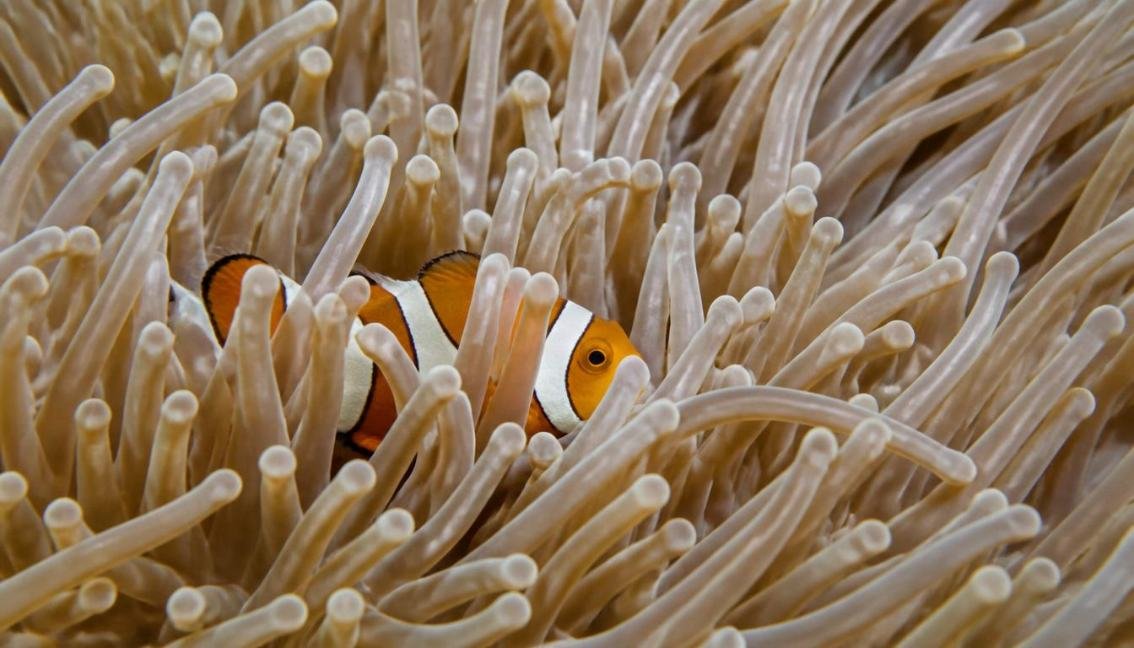
The camouflage explanation centers on how a clownfish’s white stripes may visually break up its body shape against the backdrop of an anemone’s long, similarly pale or light-colored tentacles. Research examining anemonefish coloration has suggested that species with multiple white stripes tend to be associated with anemone species that have longer tentacles, potentially allowing the fish’s pattern to blend more effectively into that visually complex background.
This camouflage function appears to work alongside, rather than instead of, the warning-signal function described earlier. In species associated with anemones offering less physical protection, blending in among the tentacles may be relatively more important, while in species living with more toxic anemones, standing out as a visual warning may take on greater relative importance. Researchers have described this as a case where the coloration likely serves multiple purposes simultaneously, rather than a single clean explanation applying uniformly across every species.
What Do the White Stripes on a Clownfish Mean?
Beyond camouflage and predator warning, some research suggests the white stripes may also play a role in recognition between individual clownfish. A widely covered study conducted by researchers at the Okinawa Institute of Science and Technology found that juvenile clown anemonefish reacted more aggressively toward other fish, and even toward painted plastic discs, that had a greater number of white bars, suggesting the fish may be capable of visually distinguishing between individuals or models based specifically on stripe count.
The researchers involved suggested this could indicate that clownfish use stripe patterns as a way of identifying members of their own species or gauging potential competition, though other scientists have expressed some skepticism about how confidently this specific behavior can be attributed to counting stripes rather than other visual cues. This particular explanation remains an active and still-debated area of research rather than a fully settled conclusion.
Do All Types of Clownfish Have Orange and White Colors?
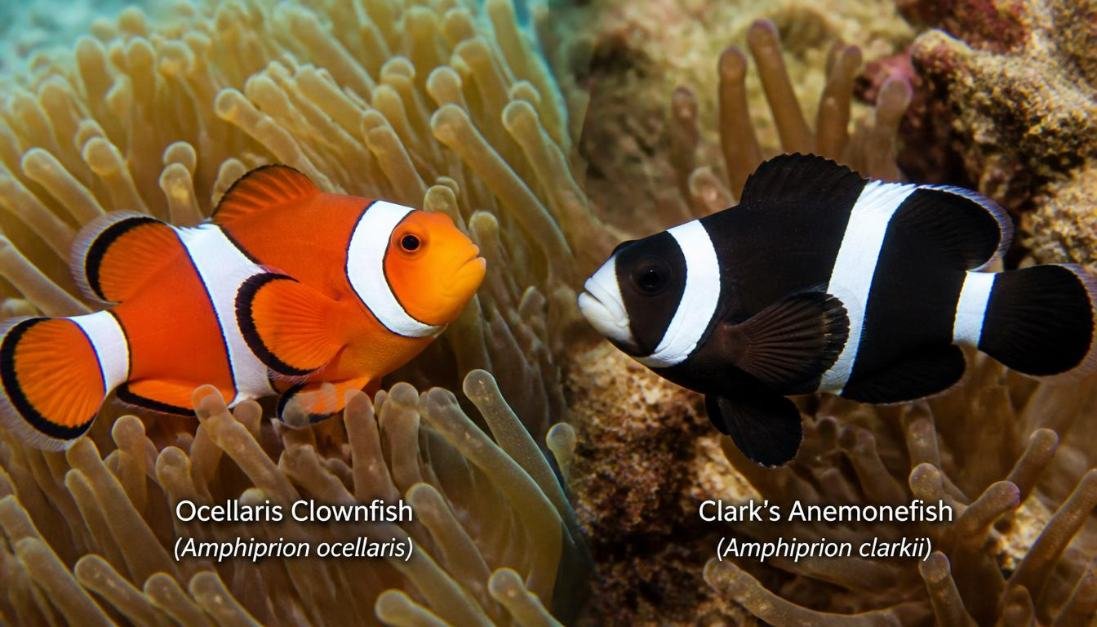
No. While the classic orange body with white stripes, most familiar from species like the clown anemonefish (Amphiprion percula), is the pattern most people picture, clownfish species show meaningful variation in both color and stripe number. Some species, like the pink anemonefish (Amphiprion perideraion), display a lighter, softer orange with only a single white stripe. Others, like Clark’s anemonefish (Amphiprion clarkii), can appear with a much darker, near-black body featuring multiple thick white bars rather than the brighter orange most associated with clownfish generally.
There are roughly 30 recognized clownfish (anemonefish) species, and their coloration varies considerably based on species, the specific anemone they associate with, and in some cases geographic location, meaning “orange and white” describes a common pattern rather than a universal rule across the entire group.
Read This Why Do Whales Breach? The Leading Theories Explained
Are Clownfish Born Orange and White or Do They Change Color?
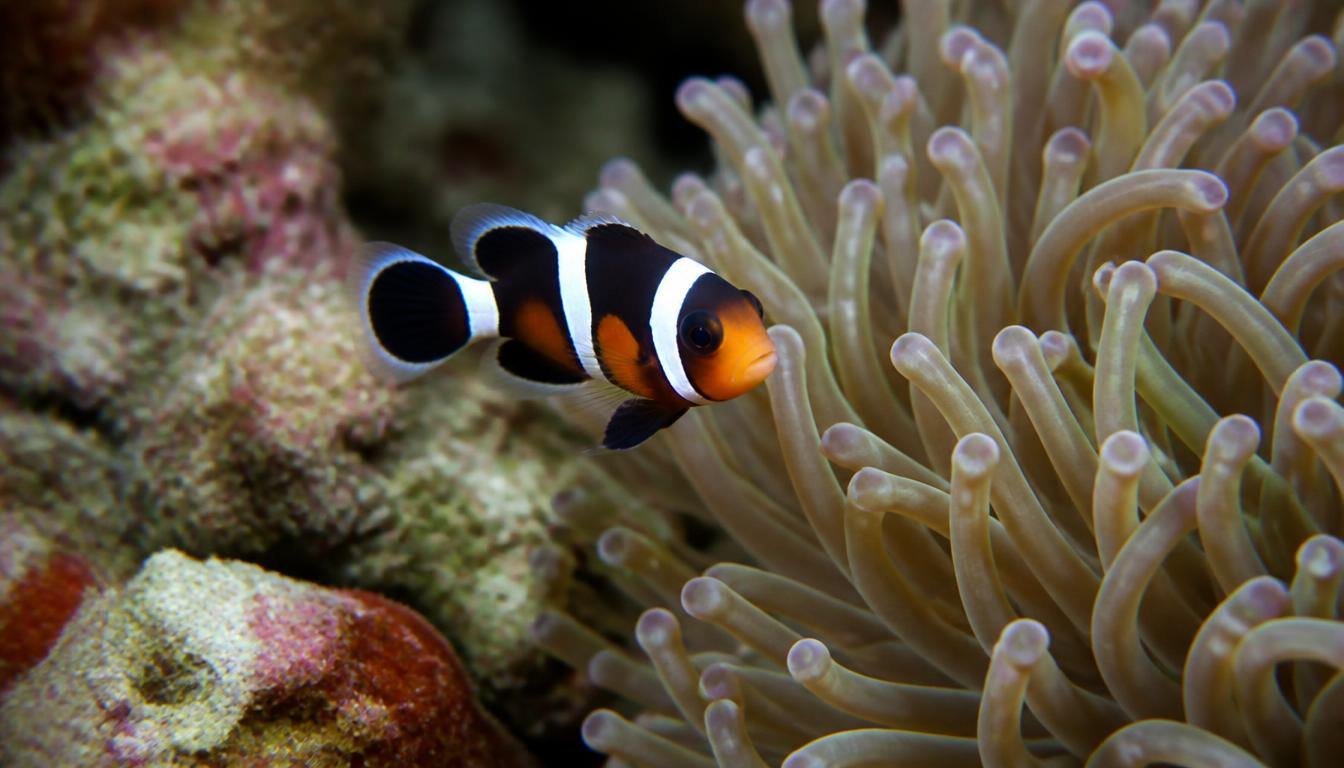
Clownfish are not born displaying their adult coloration and stripe pattern. Young clownfish undergo a developmental process, including metamorphosis from a larval stage, during which their characteristic white stripes gradually form over time rather than being present from birth. Research published in the Proceedings of the National Academy of Sciences, conducted by researchers at the Okinawa Institute of Science and Technology, found that the specific sea anemone species a young clownfish settles into can influence how quickly its white stripes develop during this process.
That same research identified thyroid hormone levels as playing a key role in this process, finding that clownfish developing within certain anemone species, such as the giant carpet anemone, showed higher thyroid hormone levels and correspondingly faster stripe formation compared to those developing in other anemone species, like the magnificent sea anemone. This suggests that a clownfish’s environment, specifically its host anemone, can directly influence the timing of its physical coloration development, not just its long-term coloration pattern.
Does a Clownfish’s Color Fade Without an Anemone?
There isn’t strong, well-documented scientific evidence establishing that adult clownfish coloration significantly fades or changes simply due to the absence of a host anemone later in life, since most existing research on anemone-related coloration effects focuses specifically on the developmental period during metamorphosis rather than ongoing coloration maintenance in adulthood. It’s worth being cautious about strong claims here, since this specific question, whether adult coloration is meaningfully affected by anemone presence or absence after development is complete, hasn’t been as thoroughly documented in available research as the developmental stripe-formation process has.
More broadly, fish coloration can sometimes be influenced by general health, diet, and environmental conditions such as lighting and water quality, particularly in aquarium settings, though these represent broader fish husbandry factors rather than something specifically documented as unique to the clownfish-anemone relationship after the juvenile developmental stage.
Read This Why Do Sharks Keep Swimming? The Real Science Behind It
Why Are Clownfish Called Clownfish?
Clownfish get their common name from their bright, bold coloration, which has long been compared to the exaggerated, colorful face paint traditionally associated with clowns. Their more formal common name, anemonefish, more directly reflects their defining ecological relationship: nearly all clownfish species live in a close symbiotic association with specific sea anemone species, using the anemone’s stinging tentacles for protection from predators while providing benefits to the anemone in return, including nutrients from their waste and, in some cases, chasing off certain anemone-eating fish.
While “clownfish” remains the more widely recognized term among the general public, both names refer to the same group of reef fish within the genus Amphiprion, and researchers often use “anemonefish” specifically to emphasize their defining ecological relationship rather than their appearance.
Common Misconceptions
Not all clownfish are bright orange with three white stripes. Coloration and stripe count vary considerably across roughly 30 recognized clownfish species, ranging from pale orange with a single stripe to dark, near-black bodies with multiple bars.
Clownfish aren’t simply “immune” to anemone stings in a way that makes their coloration irrelevant to survival. While clownfish have a protective mucus layer that helps them tolerate anemone stings, their coloration still appears to play a separate, meaningful role in either blending in or signaling that protection to predators.
Clownfish don’t have their adult stripe pattern from birth. Their characteristic white bars develop gradually during a specific developmental stage, influenced in part by the particular anemone species they settle with.
Frequently Asked Questions
What is the difference between a clownfish and an anemonefish?
There isn’t a meaningful biological difference; “anemonefish” and “clownfish” both refer to the same group of reef fish in the genus Amphiprion, with “anemonefish” emphasizing their symbiotic relationship with sea anemones.
Do clownfish change color as they age?
Clownfish undergo stripe development during a specific juvenile metamorphosis stage, but there isn’t strong documented evidence of significant further coloration change specifically tied to aging in adulthood.
How many white stripes do clownfish typically have?
Stripe count varies by species, ranging from a single stripe in some species, like the pink anemonefish, to two or three bars in others, like the common clown anemonefish.
Can clownfish live without a sea anemone?
Clownfish can survive without a host anemone, particularly in aquarium settings, though in the wild the anemone relationship provides important protective benefits, and its presence may also influence coloration development during a clownfish’s juvenile stage.
Are all clownfish species equally common in home aquariums?
No, some species, particularly the clown anemonefish, are considerably more common in the aquarium trade due to their popularity and captive breeding availability, while other clownfish species are less frequently kept.
Conclusion
The orange-and-white pattern most people associate with clownfish turns out to be the product of a much more specific, and still actively researched, biological story involving camouflage, predator warning signals, hormone-driven development, and a species’ particular sea anemone partner. Rather than one universal explanation, current science points to several overlapping functions that vary depending on the species and its specific ecological relationship. Understanding that variation offers a much more accurate picture of clownfish coloration than treating “orange and white” as a single, fixed rule across every member of this diverse group of reef fish.

Ethan Carter is a nature enthusiast and educational writer at Wonderexplained. He creates well-researched articles about animals, oceans, weather, and the natural world, making complex topics easy to understand. His goal is to provide accurate, engaging, and reader-friendly content that inspires curiosity and lifelong learning.

2 thoughts on “Why Are Clownfish Orange and White? The Science of Their Colors”