

You’ve probably seen it a hundred times. If you’ve ever wondered why do cats stretch after sleeping, your cat opens its eyes, pauses for a moment, and then slowly arches its back into that long, deliberate stretch before doing anything else. It looks almost ceremonial, like a tiny ritual your cat performs every single time it wakes up.
That’s not an accident, and it’s definitely not just for show.
Quick Answer
Cats stretch after sleeping mainly to restore blood flow and flexibility to muscles that stiffen during long periods of stillness. This instinctive movement, called pandiculation, also resets their nervous system and prepares their body for sudden movement, a survival trait passed down from wild ancestors who needed to be ready to hunt or flee at any moment.
Key Takeaways
✔ The post-sleep stretch is called pandiculation, and it’s found across many animal species
✔ Stretching restores blood circulation after long periods of stillness
✔ It resets muscles and joints, keeping them flexible and injury-resistant
✔ Wild feline ancestors relied on this instinct to stay hunt-ready at all times
✔ Cats sleep 12 to 16 hours a day, making frequent stretching essential
✔ A cat’s spine is uniquely flexible, allowing for its signature deep stretch
Table of Contents
- What Is Pandiculation, and Why Do Cats Do It?
- The Biology Behind a Cat’s Stretch
- Why Cats Sleep So Much in the First Place
- The Survival Instinct Behind the Stretch
- Why a Cat’s Spine Makes This Stretch Possible
- Do All Cats Stretch the Same Way?
- When Stretching Might Signal a Problem
- Myth vs Fact
- Quick Tips: Supporting Healthy Stretching Habits
- Frequently Asked Questions
What Is Pandiculation, and Why Do Cats Do It?
There’s actually a scientific name for that satisfying full-body stretch, and it’s called pandiculation.
Pandiculation is the involuntary stretching and yawning that happens right after waking, and it isn’t unique to cats. Dogs do it. Humans do it. Even some reptiles and birds show versions of it. What makes a cat’s version so noticeable is how complete it looks — the arched back, the extended front paws, the splayed toes, sometimes even a small yawn thrown in for good measure.
This isn’t a cat choosing to stretch the way a person might choose to touch their toes before a run. It’s closer to an automatic reflex, triggered by the nervous system as the body transitions out of deep rest.
The Biology Behind a Cat’s Stretch
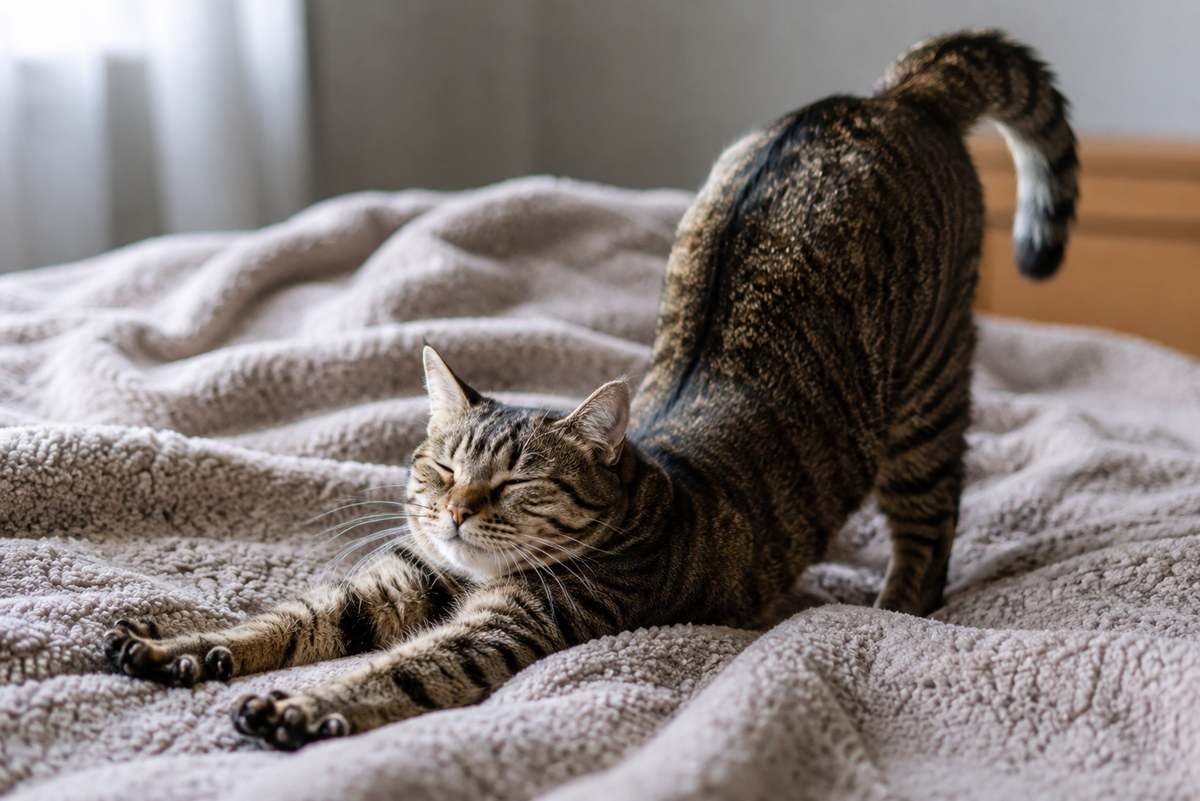
During sleep, especially the deeper stages, a cat’s muscles relax almost completely and blood flow to certain muscle groups slows down. That’s efficient for rest, but it leaves the body slightly stiff and sluggish the moment the cat needs to move again.
Stretching solves that problem almost instantly. As muscles lengthen and contract during a stretch, blood vessels open back up, oxygen-rich blood rushes back into the tissue, and the nervous system essentially “wakes up” the muscles one group at a time. Veterinary behaviorists describe this as a built-in reset button, one that gets a cat’s body from resting mode to fully alert mode in just a few seconds.
That’s also why the stretch usually looks the same every time: front paws pressed forward, back arched upward, hind legs extended one at a time. Each part of that sequence is targeting a different muscle group that needs reactivation.
💡 Did You Know?
A cat’s stretch can extend its spine by roughly 25% compared to its resting length, thanks to just how flexible feline vertebrae actually are.
Read This Why Do Cats Groom Each Other? The Real Reasons Behind Allogrooming
Why Cats Sleep So Much in the First Place
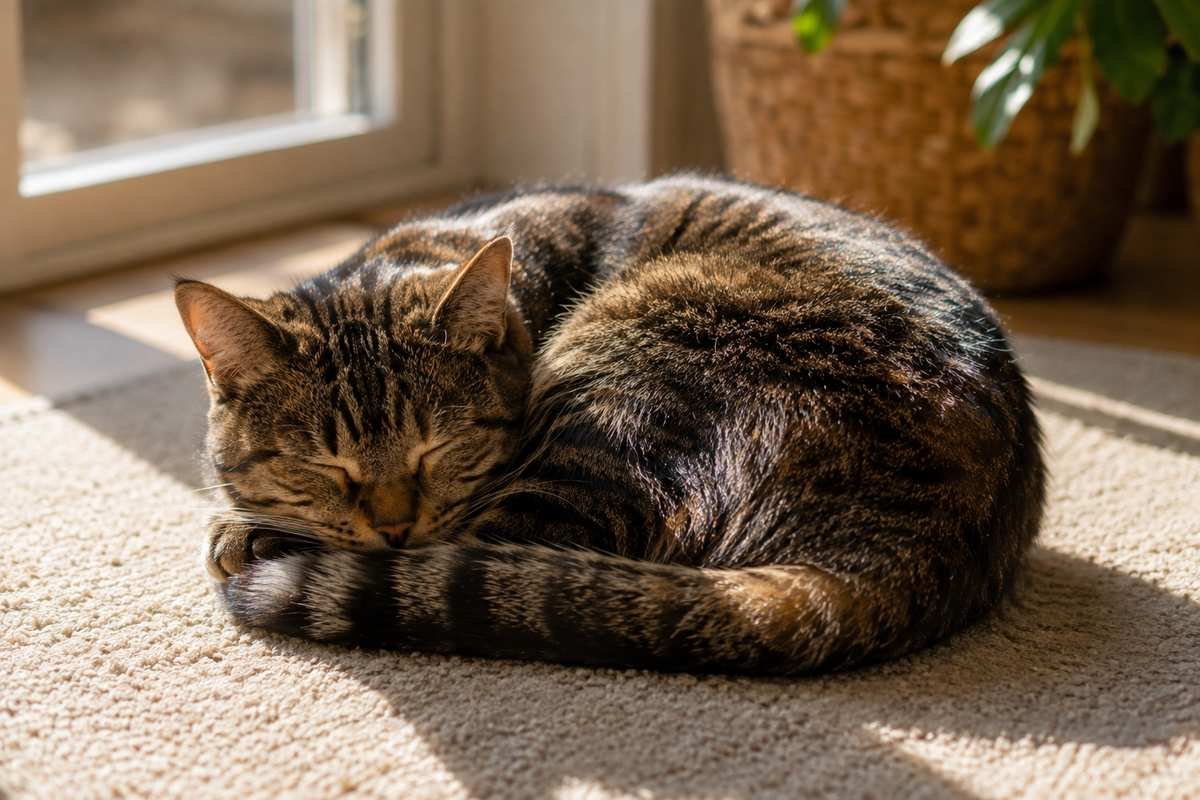
It’s hard to appreciate why stretching matters so much without understanding just how much of a cat’s day is spent sleeping.
An average adult cat sleeps between 12 and 16 hours daily, and kittens or senior cats often sleep even more. That’s not laziness. Cats are natural predators built around short, intense bursts of energy, and evolution favored conserving energy between hunts rather than staying constantly active like a grazing herbivore might.
But all that time spent still and curled up comes at a physical cost. Muscles cool down, joints stiffen slightly, and circulation slows. Frequent stretching throughout the day is essentially the price a cat pays for banking so much rest — and it’s a price their body is perfectly designed to handle.
The Survival Instinct Behind the Stretch
Here’s where the behavior becomes more than just physical maintenance.
In the wild, a cat’s ancestors couldn’t afford to wake up sluggish. A predator caught off guard, half-stiff and slow to react, risked losing a meal or becoming one. Stretching immediately after waking meant a wild cat could go from a dead sleep to a full sprint in a matter of seconds if a prey animal wandered too close, or if a threat suddenly appeared nearby.
That urgency doesn’t exist in most modern living rooms, but the instinct never disappeared. Your indoor cat stretching on the couch is running the exact same program its wild ancestors relied on to survive — it just happens to be aimed at chasing a feather toy instead of a bird.
Why a Cat’s Spine Makes This Stretch Possible
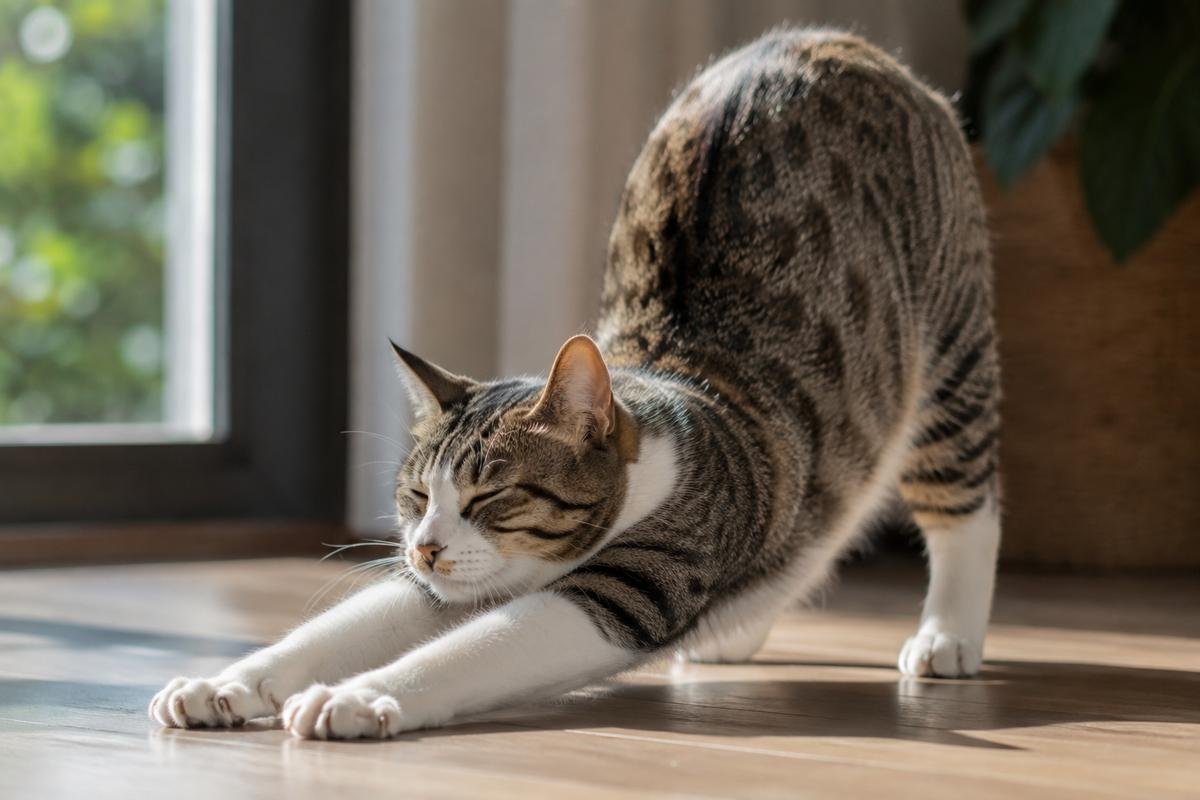
Cats can pull off a stretch that looks almost impossible for a human body, and the secret lies in their spine.
A cat’s backbone has significantly more vertebrae than a human’s, along with more flexible connections between each one. This gives their spine an unusual amount of rotational freedom, which is part of why cats can twist mid-air to land on their feet, squeeze through impossibly narrow gaps, and arch their back into that dramatic post-nap stretch without any discomfort.
Their shoulder blades aren’t rigidly attached to the rest of the skeleton either, which adds even more range of motion to the front half of the body. Anatomically, a cat’s stretch isn’t really comparable to a human stretch — it’s closer to what a gymnast’s warmup would look like if gymnasts had twice the spinal flexibility.
Do All Cats Stretch the Same Way?
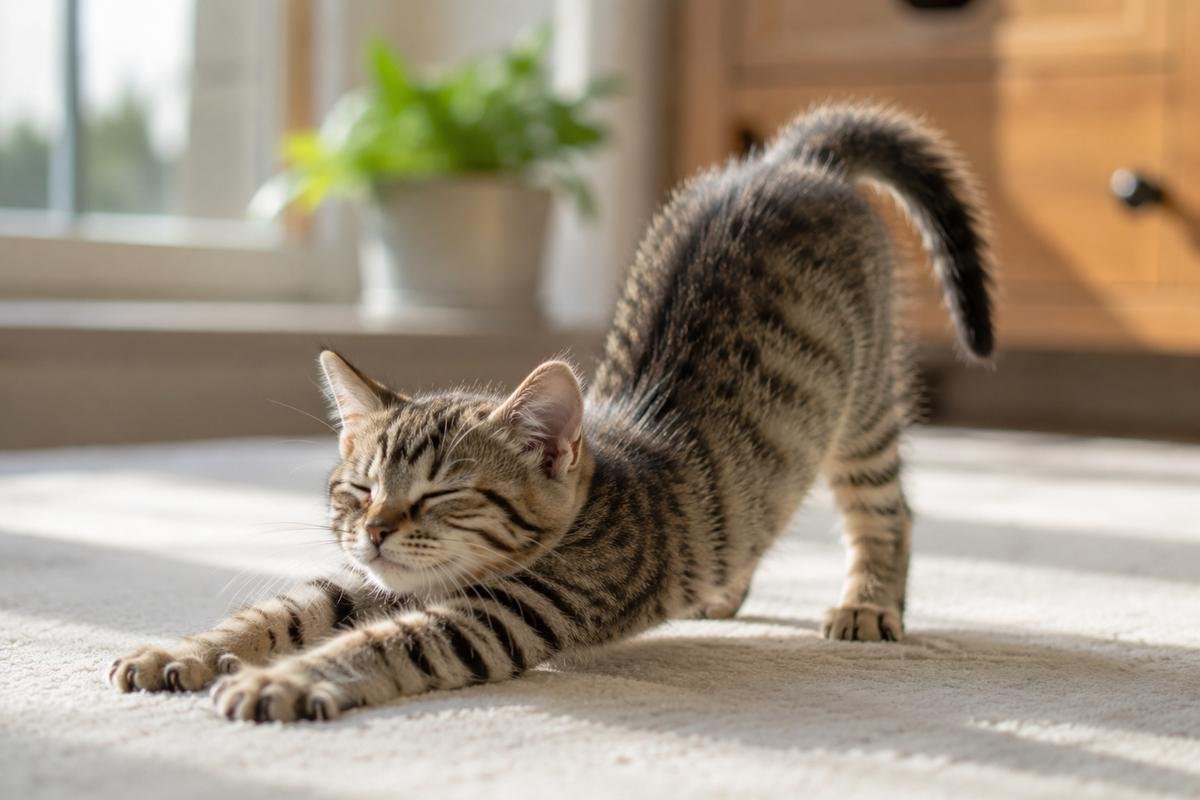
Not exactly, though the core movement stays fairly consistent across the species.
Kittens tend to stretch more frequently since they’re active in short, high-energy bursts throughout the day. Senior cats often stretch more slowly and may skip the deepest part of the arch if arthritis or joint stiffness has set in. Larger or heavier cats sometimes show a shorter, less dramatic stretch simply because of body proportions, while lean, agile breeds tend to display that classic elongated stretch most people picture.
Even individual personality plays a role. Some cats stretch dramatically every single time they wake, almost performing for an audience, while others do a quick, subtle version and move straight into whatever comes next.
Read This Why Do Cats Make Biscuits? The Real Reason Behind Kneading
When Stretching Might Signal a Problem
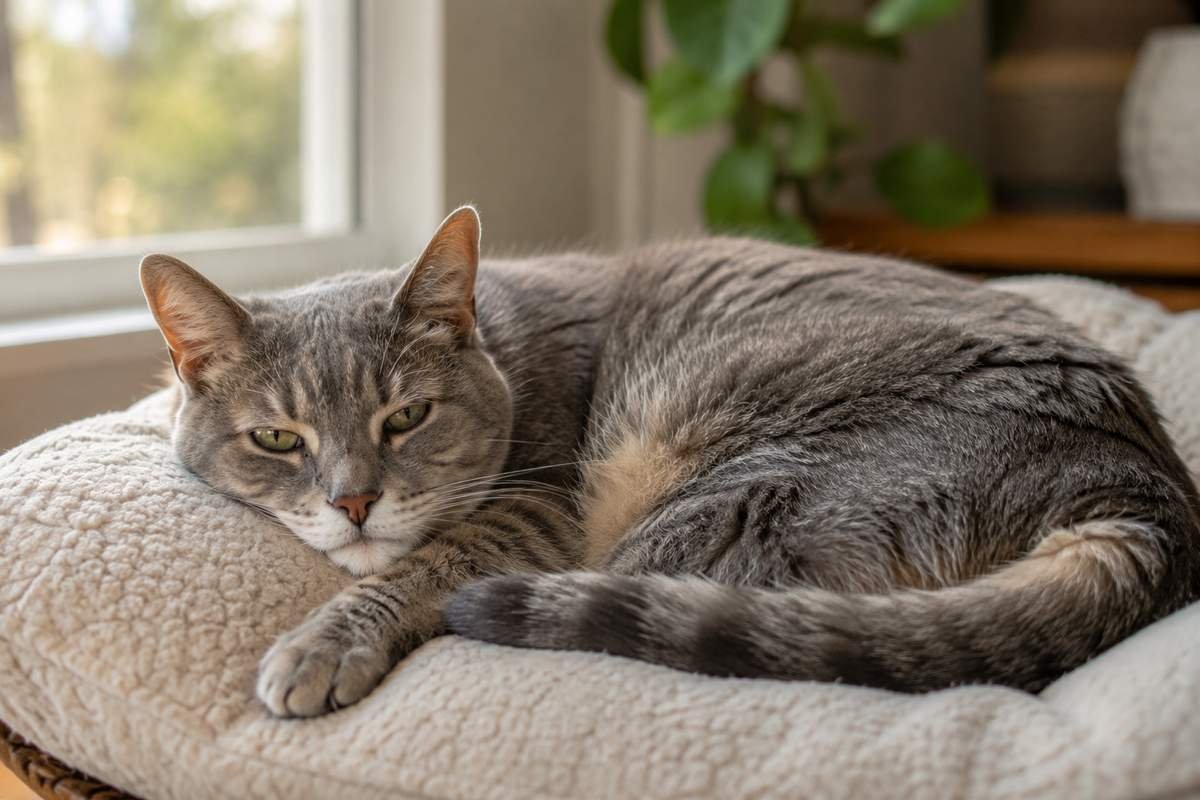
Most of the time, stretching is nothing more than a healthy, automatic habit. But changes in that pattern are worth paying attention to.
A cat that suddenly stops stretching, stretches with visible hesitation, cries out during a stretch, or seems to favor one side of its body may be dealing with joint pain, arthritis, or an injury. Since stretching relies so heavily on spinal and muscular flexibility, it’s often one of the first behaviors to change when something is physically wrong.
If a cat’s stretching habits shift noticeably over a short period, especially alongside reduced activity or reluctance to jump, that’s a reasonable reason to schedule a veterinary checkup rather than wait it out.
Myth vs Fact
| Myth | Fact |
|---|---|
| Cats stretch only because it feels good | Stretching is primarily an involuntary reflex tied to circulation and muscle readiness |
| Only cats stretch this dramatically after sleep | Many animals, including dogs and humans, show a similar reflex called pandiculation |
| A cat’s stretch is basically the same as a human stretch | A cat’s spine and shoulder structure allow far more flexibility than a human’s |
| Stretching habits never change with age | Senior cats often stretch differently due to joint stiffness or arthritis |
Quick Tips: Supporting Healthy Stretching Habits
✓ Provide soft, supportive bedding to make waking and stretching more comfortable
✓ Keep a close eye on stretching patterns as your cat ages
✓ Offer scratching posts, since scratching often pairs naturally with stretching
✓ Schedule a vet visit if stretching suddenly looks painful or limited
Frequently Asked Questions
Why does my cat stretch every time it wakes up?
Stretching after waking helps restore blood flow to muscles that stiffen during rest and prepares the body for sudden movement. It’s an involuntary reflex called pandiculation, shared by many animals, not a conscious choice your cat makes each time.
Is it normal for cats to stretch multiple times a day?
Yes, frequent stretching is completely normal, especially since cats sleep so many hours daily. Each nap ends with muscles slightly stiff, so stretching throughout the day is simply routine maintenance for their body.
Why do cats stretch their claws out when they wake up?
Extending the claws during a stretch helps engage and lengthen the muscles and tendons running through a cat’s paws and legs. It’s part of the same full-body reset that stretching provides for the rest of the body.
Do cats stretch for emotional reasons, not just physical ones?
While the primary driver is physical, a relaxed, unhurried stretch can also reflect a cat’s overall comfort and sense of safety in its environment. A stressed or anxious cat may skip stretching altogether or perform a much shorter version.
Conclusion
That familiar stretch isn’t just a cute habit your cat performs for no reason. It’s a finely tuned survival reflex, refined over thousands of years, still running quietly in the background every time your cat wakes up on the couch. The next time you watch your cat arch into that long, deliberate pose, you’re witnessing a piece of instinct that once meant the difference between catching dinner and going hungry.
Related Article
Why Do Cats Make Biscuits? The Real Reason Behind Kneading
Why Do Cats Groom Each Other? The Real Reasons Behind Allogrooming

Ethan Carter is a nature enthusiast and educational writer at Wonderexplained. He creates well-researched articles about animals, oceans, weather, and the natural world, making complex topics easy to understand. His goal is to provide accurate, engaging, and reader-friendly content that inspires curiosity and lifelong learning.

1 thought on “Why Do Cats Stretch After Sleeping? The Real Reason Explained”