

If you dropped Mount Everest into the deepest known point of the ocean, its peak would still sit more than a mile underwater. That single comparison says a lot about just how vast the ocean’s vertical world really is, and it’s part of why ocean depth is one of those topics that sounds simple until you start digging into the actual numbers. The truth is more interesting than a single figure, because the ocean floor is anything but flat, and scientists are still filling in the map as new technology comes online.
This article breaks down how deep the ocean actually is, where its deepest point is located, what lives down there, and why so much of the seafloor remains a mystery even today.
How Deep Is the Ocean? The Short Answer
The world’s ocean has an average ocean depth of about 3,682 meters (12,080 feet), based on the most recent estimate from NOAA and the Woods Hole Oceanographic Institution. The deepest part of the ocean, called Challenger Deep in the Mariana Trench, plunges to roughly 10,935 meters (35,876 feet) below the surface. Because the seafloor has mountains, trenches, plains, and canyons just like the land above sea level, depth varies enormously depending on where you measure.
What Is the Average Depth of the Ocean?
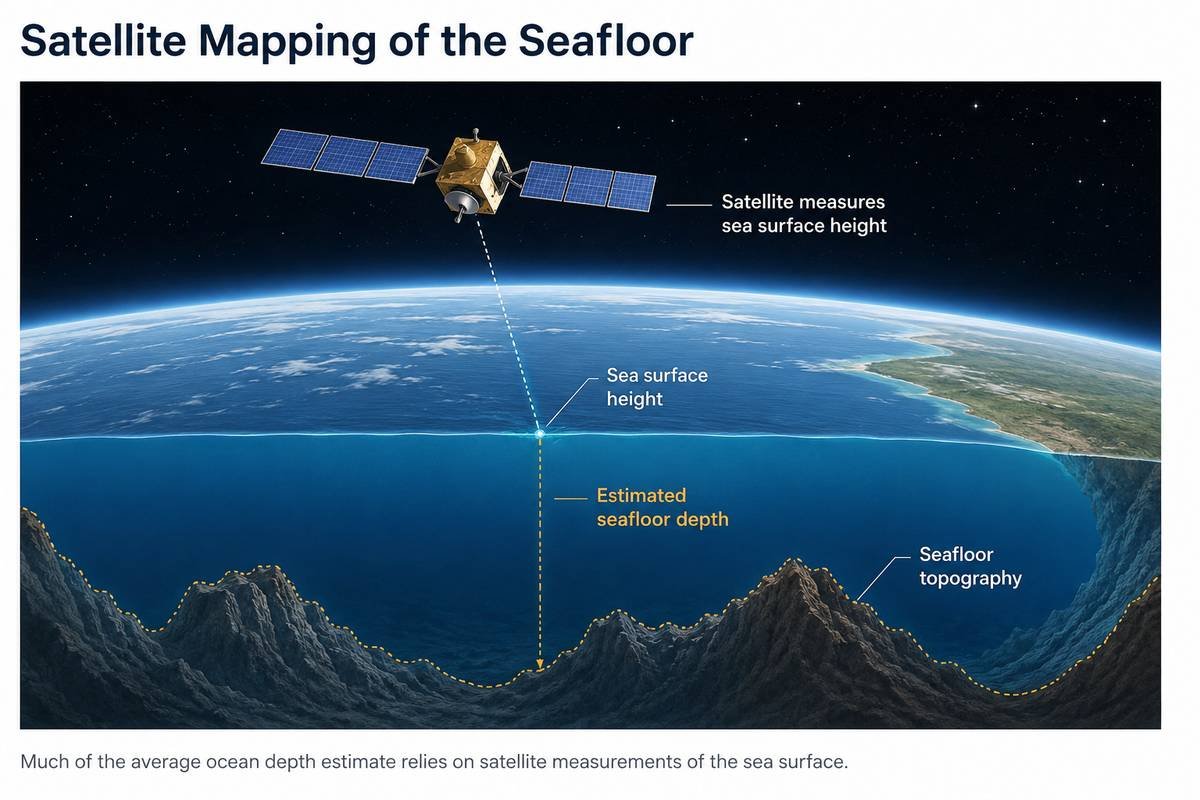
The commonly cited figure of 3,682 meters (12,080 feet) comes from a 2010 calculation by NOAA and Woods Hole Oceanographic Institution scientists, based largely on satellite measurements of the sea surface rather than direct seafloor soundings. Satellites detect subtle changes in sea surface height caused by the gravitational pull of large underwater features, like seamounts or trenches, which lets scientists estimate the shape of the ocean floor even in areas that haven’t been directly surveyed by ships.
It’s worth understanding that this number is an estimate, not a precise measurement, and different sources report slightly different values, generally somewhere between about 3,680 and 3,900 meters (roughly 12,000 to 12,800 feet), depending on the calculation method and dataset used. As more of the seafloor gets mapped in high resolution, these estimates continue to be refined.
What Is the Deepest Part of the Ocean?
The deepest known point in the ocean is called Challenger Deep, located in the southern end of the Mariana Trench in the western Pacific Ocean. It reaches a depth of approximately 10,935 meters (35,876 feet), though different expeditions using different equipment have reported slightly varying figures, generally within a range of about 10,900 to 11,000 meters. This kind of variation is normal in extreme deep-sea measurement, since even advanced sonar and pressure-based instruments carry small margins of error at that depth.
Challenger Deep is named after the HMS Challenger, the British survey ship whose crew first sounded the depths of the Mariana Trench back in 1875, long before modern sonar technology existed.
Where Is the Deepest Part of the Ocean?
The Mariana Trench, which contains Challenger Deep, runs for several hundred kilometers through the western Pacific Ocean, southwest of the U.S. territory of Guam and east of the Mariana Islands. The trench formed at a subduction zone, a location where one of Earth’s tectonic plates slides beneath another, creating a long, narrow, crescent-shaped depression in the ocean floor.
This region sits far from any coastline in the more immediately visible sense, which is part of why the trench remained largely unexplored for so long despite being known to science since the 19th century.
How Deep Is the Mariana Trench?
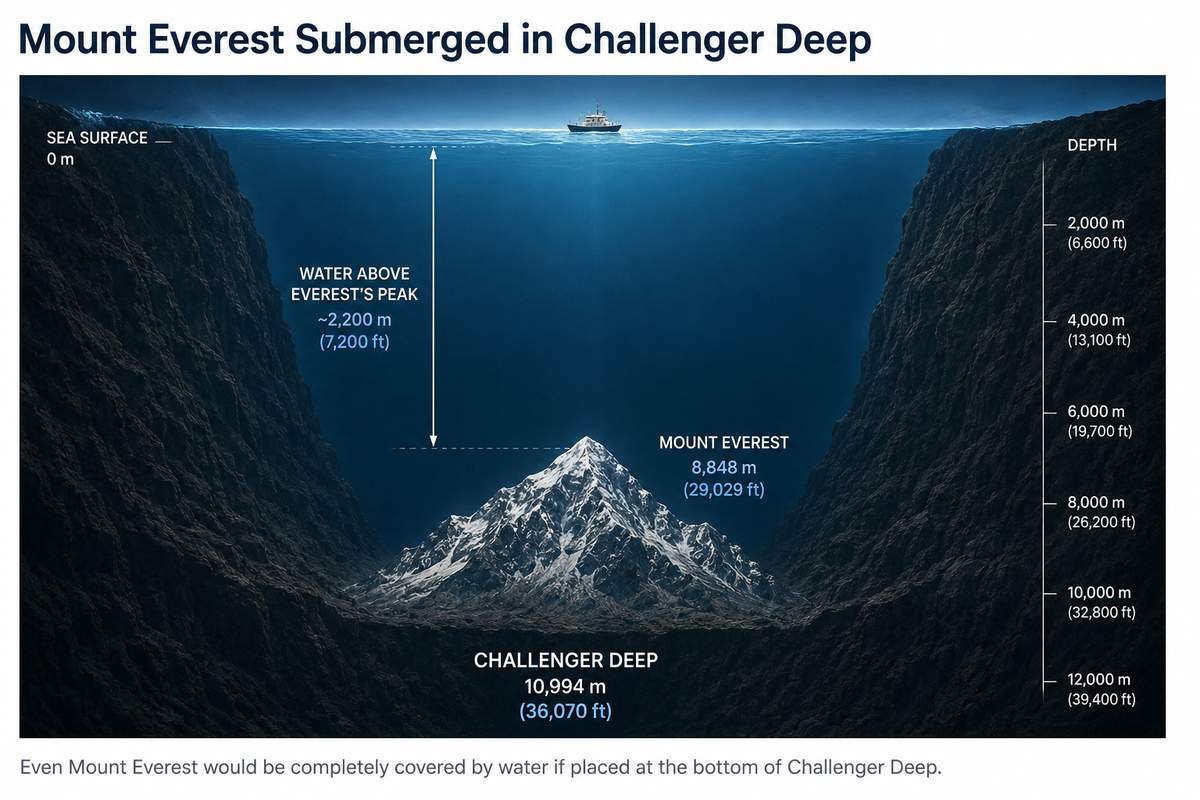
While Challenger Deep represents the trench’s single deepest known point at roughly 10,935 meters (35,876 feet), the Mariana Trench as a whole varies in depth along its length, generally ranging from around 8,000 meters to just under 11,000 meters at different points. For comparison, if Mount Everest, which stands about 8,849 meters (29,032 feet) tall, were placed at the bottom of Challenger Deep, its summit would still be covered by more than 2,000 meters of water.
Only a small number of crewed and uncrewed vehicles have ever successfully reached the bottom of Challenger Deep, starting with the Trieste submersible in 1960, followed by additional expeditions in subsequent decades, including a solo dive by filmmaker James Cameron in 2012.
What Lives in the Deepest Parts of the Ocean?
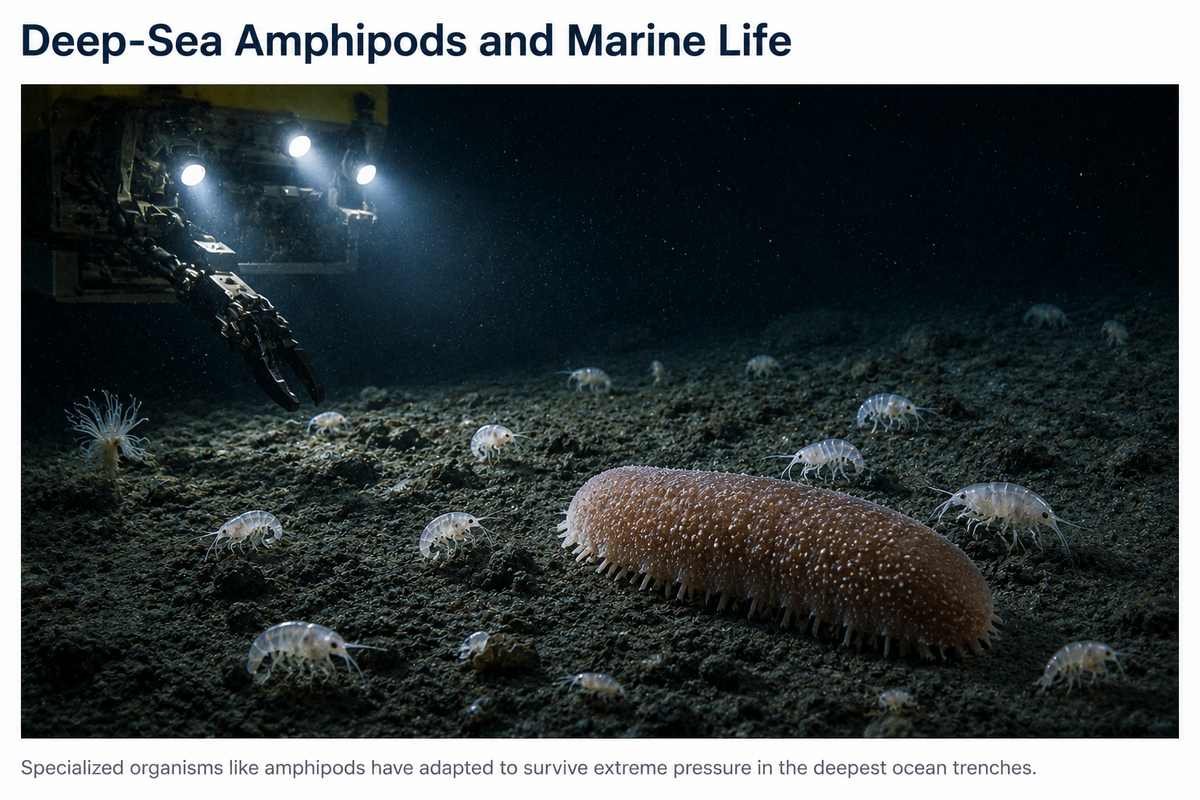
Despite the crushing pressure, near-freezing temperatures, and total darkness, life does exist in the deepest parts of the ocean, including within Challenger Deep itself. Researchers have documented organisms such as amphipods (small shrimp-like crustaceans), certain species of sea cucumbers, and specialized microorganisms adapted to survive extreme pressure, a trait scientists refer to as being piezophilic, or pressure-loving.
Fish are notably rare at the very deepest depths. The deepest-living fish ever recorded on camera, a type of snailfish, was documented at a depth of roughly 8,336 meters in a trench near Japan, still thousands of meters shallower than Challenger Deep itself. Scientists have proposed that extreme pressure likely affects biological processes in ways that make it very difficult for fish, specifically, to survive much beyond that depth range, though research into these limits is ongoing.
How Does Pressure Change With Ocean Depth?
Water pressure increases significantly and predictably as you descend, roughly by one atmosphere (about 14.7 pounds per square inch) for every 10 meters (33 feet) of depth. At the bottom of Challenger Deep, the pressure reaches over 1,000 atmospheres, meaning more than 1,000 times the pressure found at sea level, or roughly equivalent to the weight of about 50 jumbo jets pressing down on a single point.
This immense pressure is one of the main reasons deep-sea exploration requires highly specialized submersibles built with reinforced hulls, since standard equipment would be crushed almost instantly at those depths.
How Much of the Deep Ocean Has Been Explored?
As of 2026, roughly 29% of the world’s ocean floor has been mapped to modern high-resolution standards, according to the Nippon Foundation-GEBCO Seabed 2030 Project, an international effort working toward a complete high-resolution seafloor map by the end of the decade. This represents real progress, since only about 6% of the seafloor had been mapped to that standard when the project began in 2017, but it also means the large majority of the ocean floor remains unmapped in detail.
It’s important to distinguish between mapping and exploration. Mapping generally refers to measuring the shape and depth of the seafloor, often through sonar or satellite data, while direct visual exploration, using submersibles or remotely operated vehicles, has reached an even smaller fraction of the deep ocean. This is often summarized in the widely repeated observation that humans have explored more of the surface of the Moon than the deepest parts of Earth’s own oceans.
What Happens to Light as You Go Deeper in the Ocean?
Sunlight begins fading noticeably within the first 200 meters of the ocean, an area known as the epipelagic, or sunlight, zone, where the vast majority of marine life and photosynthesis-based ecosystems exist. Beyond that depth, light continues to dim rapidly, and by around 1,000 meters, in what’s known as the midnight zone, sunlight is essentially absent altogether.
This happens because water absorbs and scatters light much more effectively than air does, and it doesn’t happen evenly across colors. Red light disappears first, within the top few dozen meters, while blue light penetrates the deepest, which is part of why deep water often appears blue even in photographs taken relatively close to the surface.
Why Is the Deep Ocean So Dark and Cold?
The darkness of the deep ocean follows directly from how quickly sunlight is absorbed with depth, as explained above, leaving no meaningful natural light beyond roughly 1,000 meters. The cold is a related but separate phenomenon: surface waters are warmed directly by the sun, while deep waters are largely isolated from that heat source and instead reflect the temperature of dense, cold water that sinks from polar regions and slowly circulates through the deep ocean over long timescales.
As a result, temperatures in the deepest parts of the ocean typically hover just above freezing, generally between about 1°C and 4°C (34°F to 39°F), regardless of how warm the surface water might be in the same location.
Common Misconceptions
The ocean floor is not flat. It contains mountain ranges, canyons, trenches, and plains, much like landscapes found above sea level, which is part of why depth varies so dramatically from place to place.
Average ocean depth figures are estimates, not exact measurements. Because most of the seafloor hasn’t been mapped in high resolution, commonly cited average depth figures rely partly on satellite-based modeling rather than direct measurement everywhere.
The deepest ocean trenches are not lifeless. While biodiversity decreases significantly with depth and pressure, scientists have found organisms adapted to survive even at the bottom of Challenger Deep.
“Exploring” the ocean and “mapping” the ocean aren’t the same thing. A growing share of the seafloor has been mapped using sonar and satellite data, but direct visual exploration of the deep ocean remains far more limited.
Frequently Asked Questions
How deep is the average ocean compared to the deepest point?
The average ocean depth is about 3,682 meters (12,080 feet), while the deepest known point, Challenger Deep, reaches roughly 10,935 meters (35,876 feet), nearly three times deeper than average.
Has anyone ever reached the bottom of the Mariana Trench?
Yes, a small number of crewed and uncrewed vehicles have reached Challenger Deep, beginning with the Trieste submersible in 1960 and including a solo dive by filmmaker James Cameron in 2012.
Why hasn’t the whole ocean floor been mapped yet?
Mapping the deep ocean in high resolution requires specialized sonar equipment, extensive ship time, and significant funding, and vast stretches of remote or deep-sea areas remain difficult and costly to survey.
Is the deepest part of the ocean colder than other deep-sea areas?
Deep ocean temperatures are fairly consistent at extreme depths worldwide, generally staying just above freezing, since most deep water originates from cold water sinking near the poles.
Can any fish survive at the very bottom of the Mariana Trench?
Current scientific understanding suggests it’s unlikely, since the deepest fish ever recorded was found several thousand meters shallower than Challenger Deep, and researchers believe extreme pressure creates biological limits that fish may not be able to overcome at the very deepest depths.
Conclusion
The ocean’s depth isn’t a single number so much as a range that spans from sunlit shallows to a place deeper than Everest is tall, sitting in near-total darkness and near-freezing cold. Understanding both the average depth and the extremes, like Challenger Deep, helps put into perspective just how much of Earth’s largest habitat remains genuinely unexplored. As mapping technology continues to improve and more of the seafloor comes into focus, our picture of the ocean’s true shape, and the life it supports at every depth, will keep getting clearer.

Ethan Carter is a nature enthusiast and educational writer at Wonderexplained. He creates well-researched articles about animals, oceans, weather, and the natural world, making complex topics easy to understand. His goal is to provide accurate, engaging, and reader-friendly content that inspires curiosity and lifelong learning.

1 thought on “How Deep Is the Ocean? Exploring Earth’s Deepest Waters”