

Somewhere in the dark water off the Pacific coast, a small, nearly transparent jellyfish gets bumped by a passing fish, and its outer edge briefly flashes a soft blue-green light. Why Do Jellyfish Glow in the Dark is a fascinating question because this glowing ability, called bioluminescence, is one of the more genuinely strange and well-studied phenomena in the ocean, and it’s responsible for more than just a beautiful visual. The specific glowing proteins first isolated from jellyfish decades ago went on to transform modern biology research in ways almost nobody expected at the time.
This article breaks down how jellyfish actually produce light, what scientists think that glow is for, and why not every jellyfish species glows in the first place.
What Is Bioluminescence and How Do Jellyfish Glow?
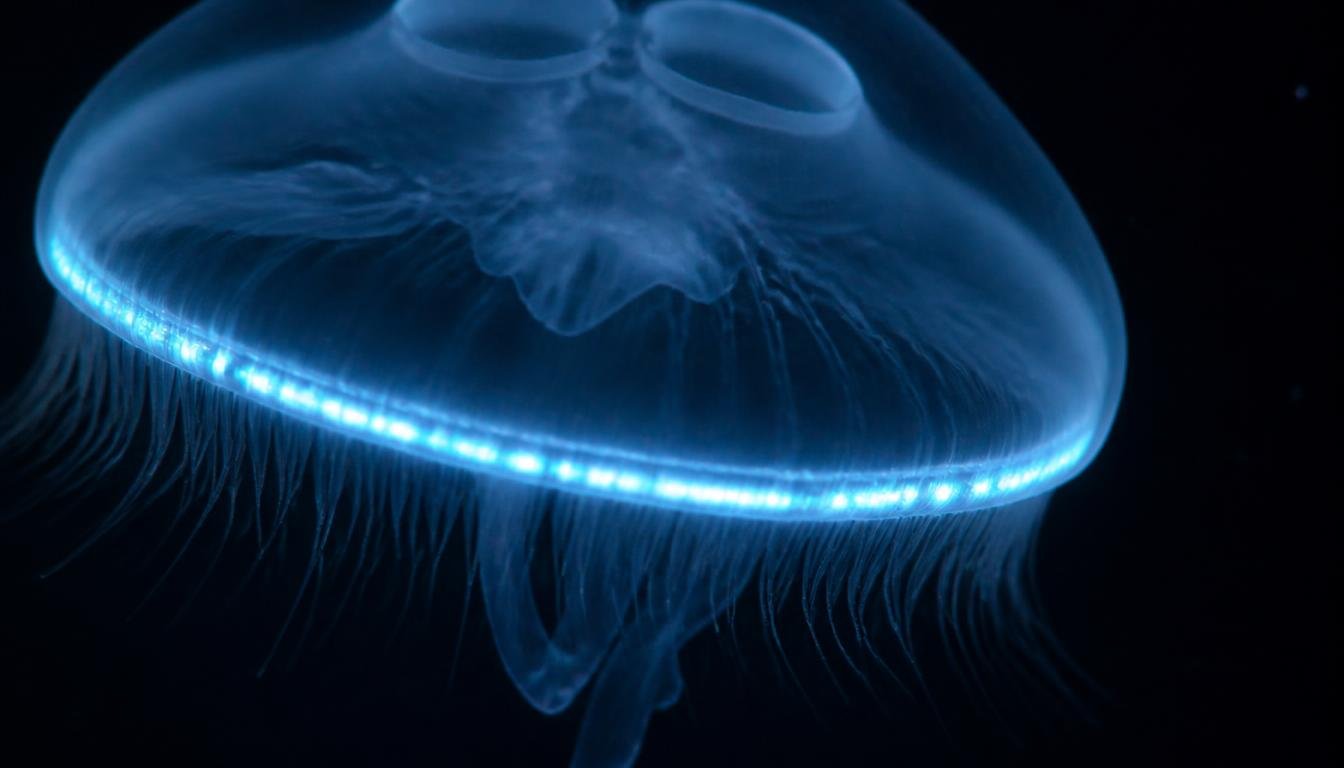
Bioluminescence refers to the ability of a living organism to produce its own light through a chemical reaction happening inside its body, rather than by reflecting external light. In jellyfish, this process was first closely studied in the species Aequorea victoria, a nearly transparent jellyfish found along the Pacific coast of North America, whose outer ring visibly glows when the animal is disturbed or touched.
Researcher Osamu Shimomura, working at Princeton University in the early 1960s, isolated two key proteins responsible for this reaction. The first, called aequorin, produces a flash of blue light specifically when it interacts with calcium ions inside the jellyfish’s cells. The second protein, green fluorescent protein (GFP), then absorbs that blue light and re-emits it as the green glow most people associate with Aequorea victoria. This two-step process, one protein generating light and a second protein converting its color, is part of what makes jellyfish bioluminescence such a distinctive natural phenomenon.
Read This Why Do Dolphins Jump Out of Water? 7 Scientific Reasons Explained
Do Jellyfish Glow to Catch Their Prey?
There isn’t strong, well-documented scientific evidence specifically confirming that jellyfish use their glow primarily as a tool for actively catching prey. While bioluminescence in various marine organisms has sometimes been associated with luring or confusing prey, the leading explanations specific to Aequorea victoria‘s glow point toward defense-related functions rather than a hunting strategy.
It’s worth being direct about the limits of current scientific understanding here. Even the Nobel Prize committee’s own published materials on the 2008 Nobel Prize in Chemistry, awarded for the discovery and development of GFP, explicitly note that scientists still don’t know with certainty why Aequorea victoria evolved its bioluminescent glow in the first place, despite decades of research building on that original discovery.
Is Glowing a Defense Mechanism for Jellyfish?
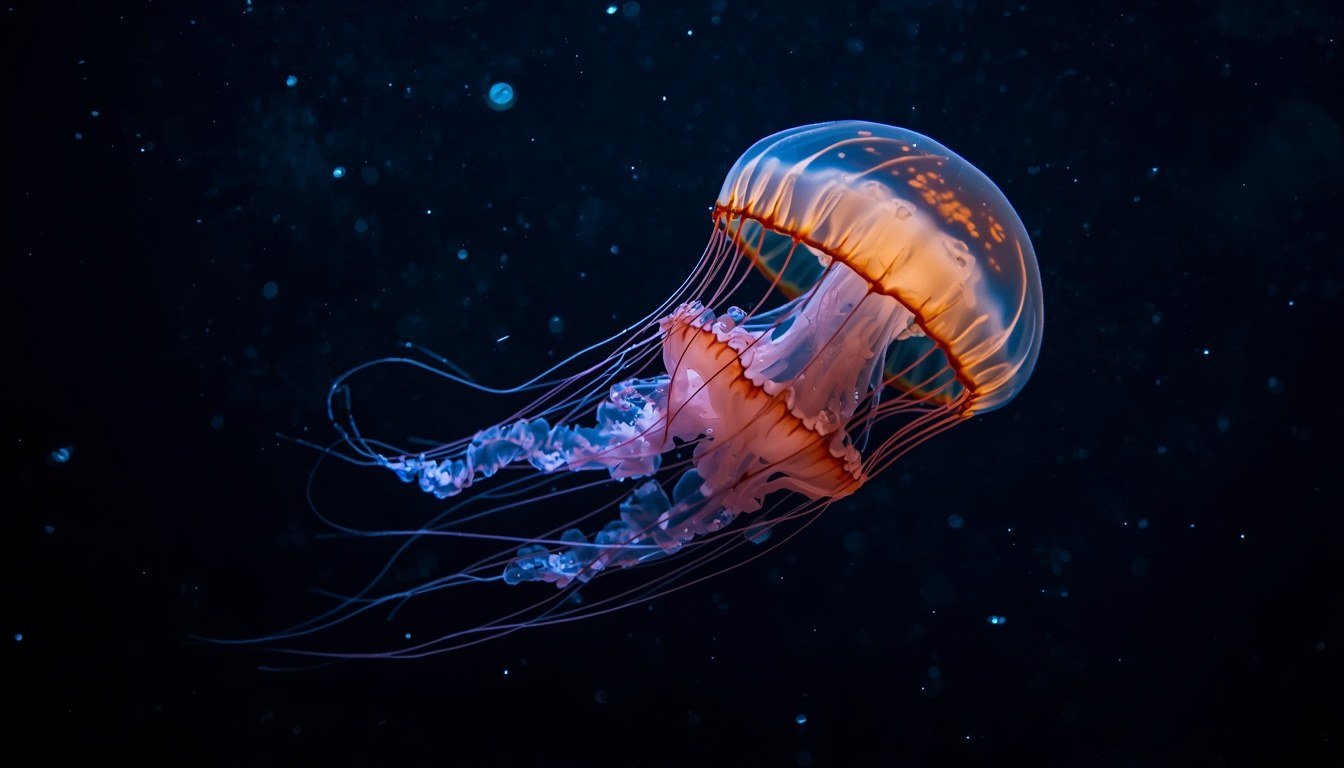
This is one of the more frequently proposed explanations, and it has reasonable observational support. Research on Aequorea victoria has noted that the jellyfish produces flashes of blue light specifically when disturbed, a pattern consistent with a startle or defensive response intended to surprise or momentarily confuse a potential predator.
This kind of defensive bioluminescence has been documented more broadly across various marine organisms, where a sudden flash of light can startle a predator, temporarily disorient it, or draw the attention of a larger secondary predator toward whatever is threatening the glowing animal. While this defensive explanation is considered plausible and consistent with how the jellyfish’s flash behavior has been observed in response to physical disturbance, it remains one proposed function among possibly several, rather than a single, fully confirmed purpose.
Do All Jellyfish Species Glow in the Dark?
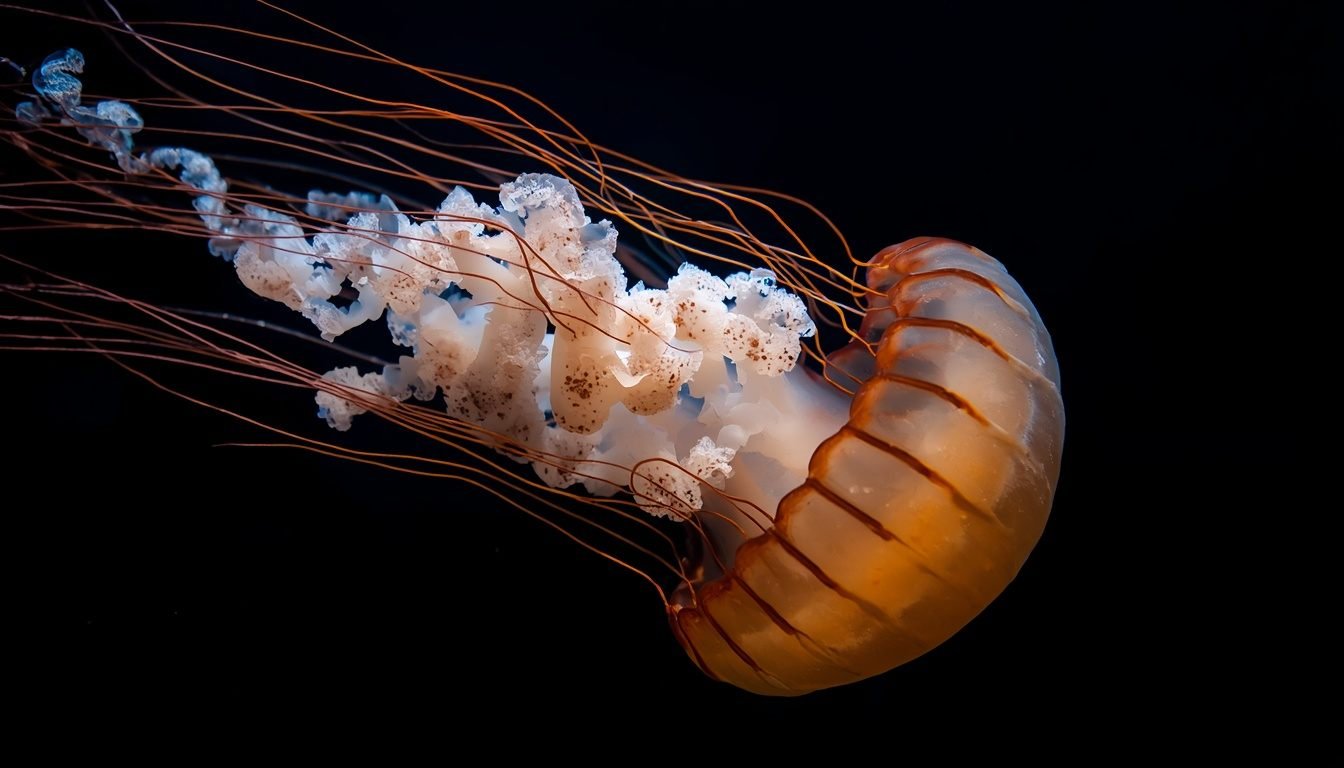
No, definitely not. Bioluminescence is not a universal trait across all jellyfish species. While it’s often discussed as though jellyfish generally glow, the ability is limited to certain bioluminescent species and isn’t a defining characteristic of jellyfish as a whole group. Aequorea victoria is one of the most extensively studied bioluminescent jellyfish specifically because its glowing proteins turned out to be so scientifically useful, not necessarily because glowing is typical of jellyfish in general.
Many common, frequently encountered jellyfish species don’t produce visible bioluminescent light at all. This distinction matters because bioluminescence is more accurately understood as a specialized trait found in specific jellyfish species, and more broadly across various marine organisms including certain fish, squid, and deep-sea creatures, rather than something that applies uniformly across the entire jellyfish category.
Read This Why Do Sea Turtles Seem to Cry? The Real Reason Behind Their “Tears”
How Do Jellyfish Use Light to Find a Mate?
There isn’t strong, specific scientific evidence confirming that jellyfish species like Aequorea victoria use their bioluminescent glow as a primary mechanism for finding or attracting mates. While bioluminescence is used for mate attraction in some other marine and terrestrial organisms, such as certain species of fireflies and some deep-sea fish, this specific function hasn’t been clearly established as a confirmed purpose behind jellyfish glow specifically.
Given that researchers still describe the overall evolutionary purpose of Aequorea victoria‘s bioluminescence as genuinely unresolved, it’s most accurate to treat mate attraction as one of several biologically plausible functions bioluminescence can serve in marine life generally, rather than a confirmed explanation specific to glowing jellyfish.
What Chemical Makes Jellyfish Glow Green and Blue?
Two specific proteins are responsible for the blue-to-green glow associated with Aequorea victoria. Aequorin, a calcium-activated protein, produces an initial flash of blue light when calcium ions bind to it inside the jellyfish’s light-producing cells. On its own, aequorin’s light would appear blue.
However, aequorin’s energy is then transferred to a second protein, green fluorescent protein (GFP), through a process called Förster resonance energy transfer. GFP absorbs that blue light energy and re-emits it as green light instead, which is why the jellyfish’s visible glow appears green rather than blue, even though the underlying chemical reaction that starts the process produces blue light first. This same light-color-shifting property is a large part of why GFP became such a valuable tool in scientific research, since it fluoresces reliably and doesn’t require the additional chemical components that aequorin needs to keep functioning.
Read This Why Are Clownfish Orange and White? The Science of Their Colors
Can Humans Use Jellyfish Glow for Science?
Yes, and this is arguably the most significant real-world impact of jellyfish bioluminescence research. After Shimomura and colleagues isolated GFP from Aequorea victoria in the 1960s, the gene responsible for producing the protein was successfully cloned in 1992, and shortly afterward, researchers demonstrated that the GFP gene could be inserted into other organisms, including bacteria, causing them to glow green as well.
This discovery transformed modern cell biology, since scientists could now attach the GFP gene to other genes of interest and use its glow to track how specific proteins move, where certain genes are active, and how various processes unfold inside living cells in real time, all without needing to kill or damage the cells being studied. This research proved significant enough that three scientists involved in discovering and developing GFP, including Osamu Shimomura, were awarded the Nobel Prize in Chemistry in 2008, and GFP and its many engineered variants remain widely used tools in laboratories around the world today.
Frequently Asked Questions
Which jellyfish species is most famous for glowing?
Aequorea victoria, sometimes called the crystal jellyfish, is the most well-studied bioluminescent jellyfish species, largely because its glowing proteins, aequorin and GFP, led to major advances in biological research.
Do jellyfish glow all the time or only sometimes?
Bioluminescent jellyfish like Aequorea victoria typically only glow when disturbed or physically stimulated, rather than producing a constant, continuous light.
Is jellyfish bioluminescence the same as glowing under a blacklight?
Not exactly, since bioluminescence involves a jellyfish producing its own light through an internal chemical reaction, while some other organisms simply fluoresce, meaning they re-emit external light like ultraviolet light rather than generating their own.
Why did scientists win a Nobel Prize for studying jellyfish glow?
The 2008 Nobel Prize in Chemistry recognized the discovery and development of green fluorescent protein (GFP) from jellyfish, since the protein became an essential tool for visualizing biological processes inside living cells.
Are glowing jellyfish dangerous to humans?
A jellyfish’s ability to glow isn’t related to how dangerous it is; sting risk depends on the specific species and its venom, not on whether that species happens to be bioluminescent.
Conclusion
Jellyfish bioluminescence turns out to be both a genuinely interesting natural phenomenon and, somewhat unexpectedly, one of modern biology’s most valuable research tools. The blue-to-green light produced by Aequorea victoria‘s aequorin and GFP proteins likely serves a defensive function, startling or confusing potential predators, though scientists are honest that the full evolutionary story behind why this particular jellyfish glows remains an open question even decades after Shimomura’s original research. What’s much less uncertain is the impact that discovery has had far beyond the ocean, reshaping how researchers study living cells and earning a Nobel Prize along the way.

Ethan Carter is a nature enthusiast and educational writer at Wonderexplained. He creates well-researched articles about animals, oceans, weather, and the natural world, making complex topics easy to understand. His goal is to provide accurate, engaging, and reader-friendly content that inspires curiosity and lifelong learning.

1 thought on “Why Do Jellyfish Glow in the Dark? Bioluminescence Explained [2026]”