

A gull swoops down, grabs a starfish by one arm, and pulls. Rather than being dragged off entirely, the starfish simply lets the arm go and crawls away with four instead of five. That kind of survival trick would be fatal for almost any other animal, but for a starfish, it’s just the beginning of a slow, genuinely remarkable rebuilding process. Starfish regeneration is one of the more well-studied examples of animal regrowth in the natural world, and it works in ways that go well beyond simply patching up a wound.
This article breaks down how starfish regrow lost arms, why their bodies are built to make this possible, and what happens in the rare cases where an entire new starfish can grow from just one detached arm.
How Do Starfish Regrow Their Arms?
When a starfish loses an arm, whether from a predator attack or a deliberate self-defense response, the wound at the injury site seals itself off fairly quickly, and specialized cells then begin migrating to the area to start rebuilding the missing tissue. According to the Seattle Aquarium, once the injury site seals, these cells slowly regrow the arm over an extended period, which can take a year or even longer to complete.
Research on starfish regeneration generally describes this process as following a consistent multi-phase pattern across species: an initial wound-healing and repair phase, followed by a phase involving the formation of a mass of proliferating, stem-cell-like tissue called a blastema at the injury site, and finally a longer phase of tissue growth and differentiation, during which the new arm gradually develops its full structure, including muscle, skin, and the internal organs needed for it to function.
Read This Why Do Jellyfish Glow in the Dark? Bioluminescence Explained [2026]
What Happens When a Starfish Loses an Arm?
Arm loss in starfish generally happens in one of two ways: through outside damage, such as a predator biting or pulling an arm free, or through a deliberate, self-initiated process called autotomy, in which the starfish essentially chooses to detach its own arm, often as an escape strategy when caught by a predator. Research documented in studies on starfish autotomy has described this detachment as a somewhat gradual process in some species, beginning with a small crack forming on the underside of the arm before the tube feet on both sides work to pull the arm free, a process that can take roughly an hour to fully complete.
Once separated, the wound at the base of the remaining arm stump typically heals within about ten days, according to research summarized in Wikipedia’s overview of starfish asexual reproduction, though survival immediately after arm loss isn’t guaranteed, since freshly wounded tissue can be vulnerable to infection during that initial healing window.
Why Can Starfish Regenerate Lost Arms?
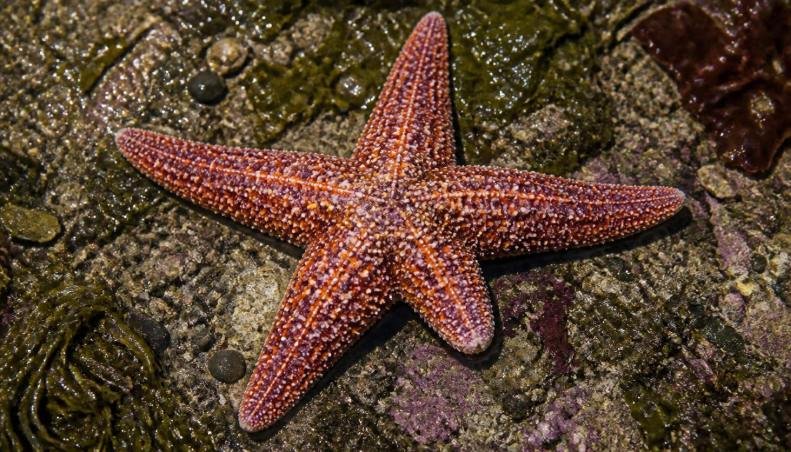
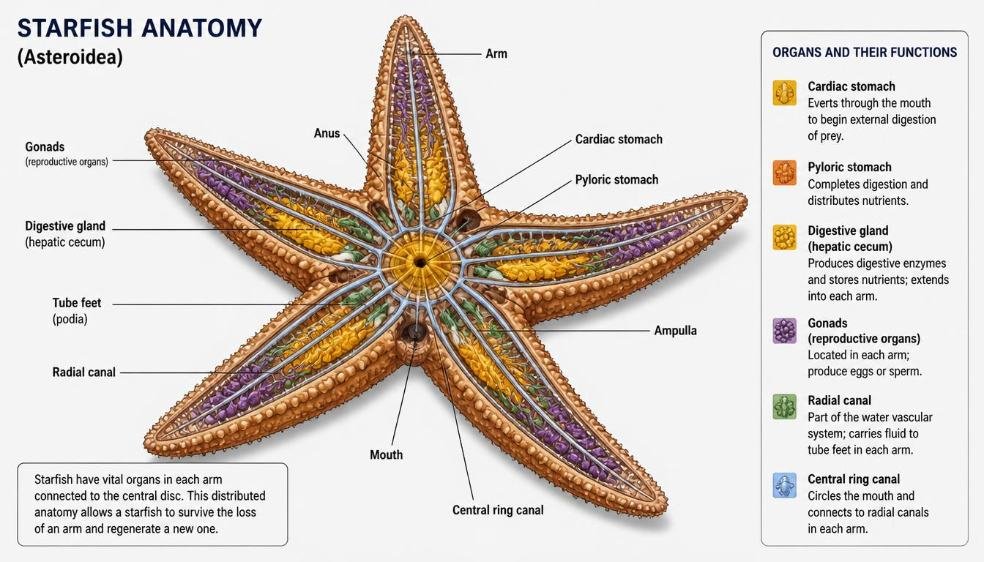
Starfish are able to regenerate lost arms largely because of how their internal anatomy is organized. Rather than housing all of their vital organs in one central location the way many other animals do, starfish have organs, including parts of the digestive tract and reproductive system, distributed into each individual arm, all connected back to the central disc, which contains the mouth and stomach. This distributed anatomy means that losing a single arm doesn’t necessarily damage organs a starfish can’t survive without, since duplicate structures typically exist in the remaining arms and central disc.
Beyond this anatomical redundancy, starfish also rely on specialized regenerative cells capable of proliferating rapidly at an injury site and eventually differentiating into the various tissue types, including skin, muscle, and even nerve tissue, needed to rebuild a functional arm. This combination of a body plan built for redundancy and a genuinely active regenerative cellular process is what makes starfish regeneration possible in a way that isn’t available to most other animals.
How Long Does It Take a Starfish to Regrow an Arm?
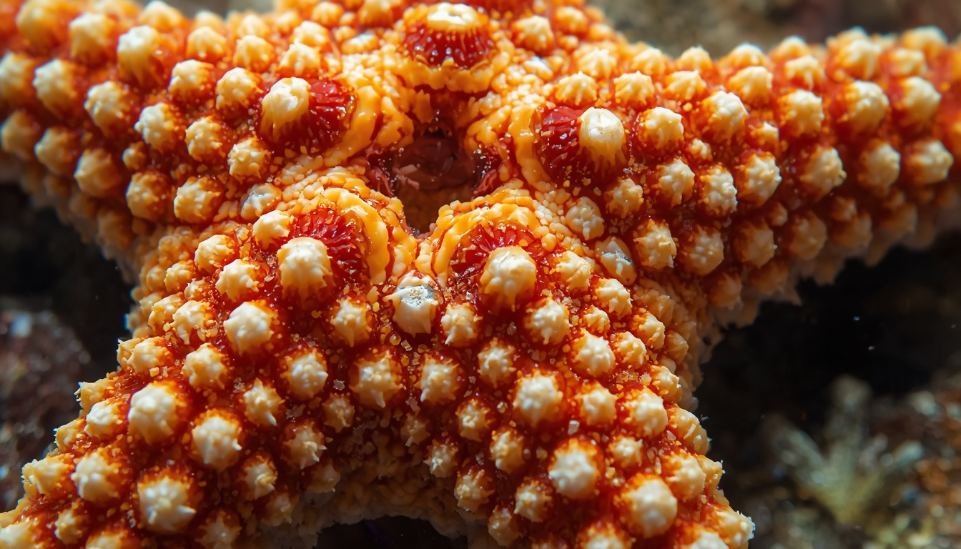
Starfish regeneration is a notably slow process, generally taking anywhere from several months to over a year to fully complete, depending on the species and the extent of the original injury. According to the Seattle Aquarium, regrowing a lost arm can take a year or even longer, and research on specific regeneration timelines has found similarly extended timeframes, with one study noting that regenerating a full arm and portion of the central disc from a smaller starting fragment took approximately ten months.
It’s worth noting that regeneration speed can also depend on factors like water temperature, the starfish’s overall health, and how much of the original arm or central disc remained intact after the initial injury, meaning there isn’t one single, universal timeline that applies precisely across every species and situation.
Can All Starfish Regrow Their Arms?
No, this ability isn’t universal across every starfish species, even though it’s a defining trait associated with the group as a whole. According to the Seattle Aquarium and other research on echinoderm regeneration, arm regrowth is possible only if a portion of the central disc remains intact, since the central disc contains critical structures, including the nerve ring and key organs, needed to direct and support the regeneration process. A starfish that loses its entire central disc generally cannot regenerate, regardless of species.
Additionally, regenerative capability and speed can vary meaningfully between different starfish species, with some species demonstrating notably fast or extensive regeneration abilities while others regenerate more slowly or with more limited capacity, reflecting genuine biological variation across the roughly 1,500 to 2,000 known starfish species rather than one single, uniform regenerative process shared identically by all of them.
Read This Why Do Sea Turtles Seem to Cry? The Real Reason Behind Their “Tears”
Can a Starfish Grow a New Body From an Arm?
Yes, in certain species, though this specific ability isn’t universal across all starfish. Some starfish species are capable of regenerating an entirely new individual from a single detached arm, but only if a sufficient portion of the central disc remains attached to that arm. Because the central disc contains the nerve ring and key organs necessary for coordinating growth and survival, an arm that breaks off without any attached disc tissue generally cannot regenerate into a whole new starfish on its own.
This process, sometimes referred to as fission or a form of asexual reproduction, has been documented in certain species and generally takes an extended period, with research describing full development of a new disc and small arms from a minimal starting fragment taking around ten months to complete. It’s important to note that this whole-body regeneration from a single arm is a capability specific to certain species rather than something every starfish can accomplish.
Why Is Starfish Regeneration Important?
Beyond being a fascinating natural survival mechanism, starfish regeneration has become genuinely significant to broader scientific research, since starfish serve as a useful model organism for studying how regeneration works at a cellular and genetic level. Researchers studying starfish regeneration have used the process to investigate how stem-cell-like proliferating cells form, migrate, and differentiate into complex tissue types, including nerve cells, insights that carry potential relevance for understanding regenerative processes more broadly across the animal kingdom.
Starfish regeneration is also ecologically significant, since the ability to survive and recover from arm loss allows starfish to persist despite regular predation pressure, helping maintain stable population levels in ecosystems where starfish often serve an important role as predators themselves, particularly in controlling shellfish and other invertebrate populations along coastlines.
Read This Why Are Clownfish Orange and White? The Science of Their Colors
Frequently Asked Questions
Do starfish feel pain when they lose an arm?
Starfish don’t have a centralized brain and their nervous system is fundamentally different from that of vertebrates, so while they can respond to and detect certain stimuli, it isn’t accurately established that they experience pain in the way vertebrate animals do.
Can a starfish regrow more than one arm at a time?
Yes, if a starfish loses multiple arms as long as its central disc remains sufficiently intact, it’s generally capable of regenerating each missing arm simultaneously, though this places greater demands on the animal’s overall recovery process.
Does cutting a starfish in half create two new starfish?
Not automatically; a new individual can only fully regenerate from a fragment that includes a sufficient portion of the central disc, meaning simply cutting a starfish in half doesn’t guarantee that both halves will survive and regenerate.
Why do starfish lose their arms in the first place?
Arm loss typically results either from predator attacks or from a deliberate self-defense response called autotomy, in which the starfish intentionally detaches an arm to escape a threat.
Are all starfish species equally good at regenerating?
No, regenerative speed and capability can vary meaningfully between different starfish species, meaning some species regenerate more quickly or extensively than others.
Conclusion
Starfish regeneration is possible because of a genuinely unusual combination of biology: a body plan that duplicates vital organs across each arm and the central disc, paired with specialized cells capable of rebuilding lost tissue from scratch. While the process is slow, often taking many months or even more than a year, it gives starfish a survival advantage most animals simply don’t have, and in certain species, it can even allow an entirely new individual to grow from a single arm. That resilience is a big part of why starfish have become such a valuable subject for scientists working to understand regeneration more broadly, well beyond the tide pools where these animals are usually found.

Ethan Carter is a nature enthusiast and educational writer at Wonderexplained. He creates well-researched articles about animals, oceans, weather, and the natural world, making complex topics easy to understand. His goal is to provide accurate, engaging, and reader-friendly content that inspires curiosity and lifelong learning.
